Busy Isn’t Growing: A 2026 Guide for Steel Fabricators
Admin User
July 8, 2026
Demand for structural steel is strong in 2026. That part is easy. The hard part is turning a busy shop into a growing shop - one that adds margin, not just hours.
Backlogs are full, margins are thin, skilled people are impossible to find, and material prices move under your feet. Being busy and being profitable are not the same thing, and 2026 is the year that gap gets exposed. Here's how to close it.
The 2026 ground truth
Demand is real, and it's concentrated. Mill capacity utilization is running in the low-80s, but the strength sits in a handful of sectors: data centers, reshoring, infrastructure, and energy.
Lead times are long. Roughly 14–20 weeks from order to job site. Capacity is tight, and shops that procure early have a scheduling advantage.
Material pricing is elevated and volatile. Hot-rolled coil above $1,100/ton, plate north of $1,200/ton, with Section 232 coverage shifting again in June. Material cost is a moving target you price for, not assume.
Labor is the ceiling. Construction needs about 349,000 net new workers in 2026, mostly to replace retirements. Welders, fitters, and detailers are hardest to fill. Translation: you cannot hire your way to growth in 2026.
1. Aim at where the steel is actually going
Point your capacity at work that's expanding. Data centers are the defining demand story - enormous steel volume, but they pay for speed and schedule certainty above all. Reshoring and advanced manufacturing favor shops that handle complex, fast-moving scopes. Infrastructure is steadier and stabilizes backlog when private work softens. Energy is steel-intensive enough to be its own lane: utility-scale wind runs about 115 tons per megawatt.
The move: look at your last 12 months of awarded work. What share came from growing sectors? If most of your backlog is tied to a softening market, your growth is really managed decline.
2. Growth is a throughput problem, not a sales problem
You can always find more work to quote. What you can't find is the capacity to deliver more tons, on schedule, at margin. So the question isn't how do I sell more - it's where is the bottleneck capping what I can produce, and how do I widen it?
For many shops in 2026 the constraint isn't the floor. It's the front end: detailing capacity, RFI cycles, approval delays. If your fitters are waiting on drawings, buying another welder doesn't help. Look at:
● Detailing and model prep - work stuck in the model isn't on the floor earning.
● Rework rate - throughput you already paid for and threw away. It's usually higher than owners think.
● Material flow - steel double-handled or waiting on a missing piece is silent lost capacity.
● Bid-to-award lag - slow estimating loses good jobs and wastes hours on jobs you'll never win.
Fix the constraint and your existing shop produces more tons without a single new hire.
3. Win better work, and protect the margin on it
More volume at thin margin can shrink a fabrication business. Know your bid-to-win ratio by job type - if you win 1 in 3 of one kind and 1 in 12 of another, you're donating estimating hours. Qualify before you quote: right sector, realistic schedule, GC that pays on time. A 20-minute go/no-go saves days of takeoff.
Lock material early - at 14–20 week lead times, procurement timing is a competitive weapon and a selling point to GCs terrified of schedule risk. And watch backlog quality, not just size: a big backlog of thin-margin, slow-pay jobs is a liability dressed as an asset.
4. Beat the labor ceiling at the front end
You can't hire your way out when 349,000 workers are missing and your best people are aging toward retirement. So do the opposite: stop spending scarce skilled labor on work that doesn't require their hands.
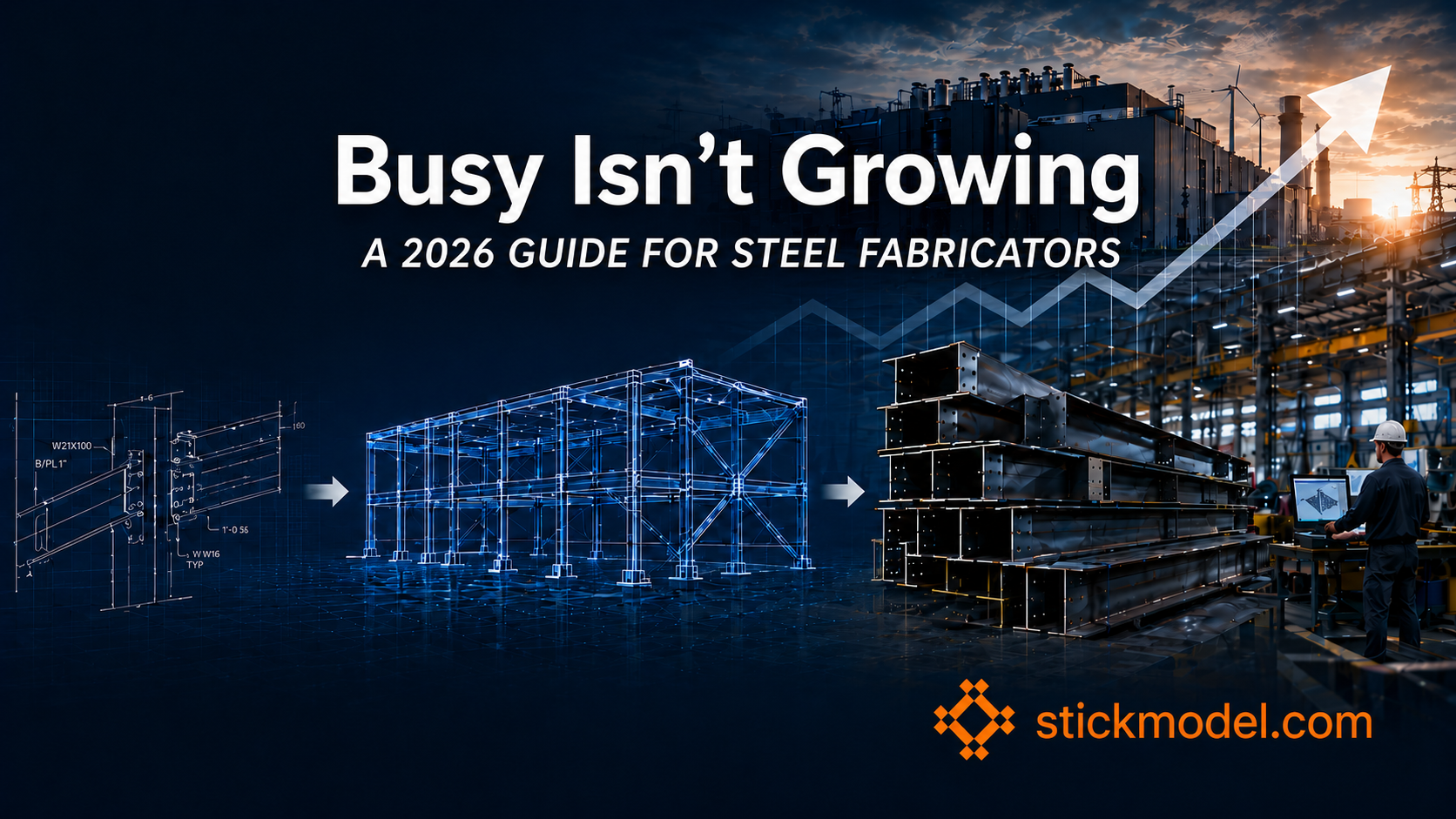
The highest-return automation in a fab shop usually isn't the floor robot everyone pictures. It's the front-end work bottlenecking everything downstream - takeoff and quantity surveying, converting 2D drawings into a constructible 3D model, and generating an order-ready bill of materials. Slow, repetitive, detailer-dependent work that caps throughput and burns the scarcest people you have.
Whether you automate it, outsource it, or restructure how the front end runs, the principle holds: in a labor-constrained market, taking detailing-prep load off your skilled team frees them for the high-judgment work only they can do - and shortens the lag between award and steel on the floor.
5. Measure five numbers, not forty
● Throughput - tons shipped per labor hour. This is your real capacity.
● Bid-to-win ratio, by job type - where you're competitive, where you're wasting time.
● Rework rate - margin thrown away, capacity lost to redos.
● Backlog by margin and sector - not just how much, but how good.
● Schedule reliability - in a long-lead market, this is increasingly what you sell.
If a number doesn't change a decision you'd make, stop tracking it.
Your first 90 days
1. Run the demand audit. What share of last year's work came from growing sectors? Re-aim BD accordingly.
2. Find your real bottleneck. Walk the process from RFQ to shipment and name the one constraint capping throughput.
3. Take one task off your skilled team's plate. Pick the slowest, most detailer-dependent front-end task and automate or outsource it.
The bottom line
2026 hands fabricators a genuinely strong demand environment - but demand alone doesn't grow a business. The shops that pull ahead won't be the busiest. They'll be the ones that aim at the right work, widen their real bottleneck, win better jobs instead of just more jobs, and protect their scarcest resource: skilled people.
Be busy and profitable. That's the whole goal.
What's the biggest constraint on growth in your shop right now - labor, throughput, or cash? That's usually where the next dollar of growth is hiding.
Sources :
· ABC: Construction Industry Must Attract 349,000 Workers in 2026
· Terrapin Construction Group: Commercial Construction Material Lead Times 2026
· IMARC Group: Hot Rolled Coil Pricing Report
· Steel Market Update: Expect continued incremental sheet price gains
· C.H. Robinson: Updates to Section 232 Tariffs on Steel, Aluminum, Copper (June 2026)
· Crane Worldwide Logistics: Section 232 Tariff Update June 2026
· American Iron and Steel Institute: Industry Data
· SteelRadar: U.S. crude steel production increased 9.7%
· Construction Owners: Data Center Construction Boosts U.S. Contractor Backlog
· The Fabricator: The industries shaping steel demand in 2026
· Constructalia (ArcelorMittal): Steel is the power behind renewable energy